
Health
New weapons screening at Cape Breton hospital

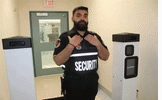
CAPE BRETON, N.S. – A new artificial intelligence (AI)-powered weapons detection screening system has been deployed at the entrance of Cape Breton Regional Hospital’s emergency department. Nova Scotia Health says it’s part of a provincial rollout to help enhance safety for patients, visitors and staff.
“These have been installed at a number of facilities throughout the province,” said Cathy Lynn Howley, Eastern Zone director of perioperative services and the site lead at the Cape Breton Regional Hospital.
“Central Zone and Northern Zone have already done a pilot with them, and so the intent is really to ensure that we are maintaining the safety and security of the patients, visitors, and families within the building, and to prevent any weapons or devices that could be used as a weapon from entering the emergency department.”
Anyone entering the emergency department at the hospital will be screened when they walk through the system. Items that are classified as a weapon or could be used as a weapon, such as pocketknives, multi-tools with blades or boxcutters, will be prohibited.
“As the patients with families would be entering the building, they’ll walk through the detection system and it detects materials, type and shape, and then if an item is detected, the security team would then search any bags or what have you that may be carrying those items,” she said. “Then the items would be confiscated, or patients would be asked to return to their vehicle and secure them in their vehicle.
“We’ve had some tremendous feedback, in particular from staff,” Howley added. “They feel more confident and reassured knowing that these additional steps are being taken.”
Howley said the first unit will be at the emergency department entrance, and more could be added to other areas of the hospital in the future.
The units are mobile as well, so they can be relocated to different parts of the hospital if there’s construction going on and an alternate entrance to an area must be used.
Dean Stienburg, director of security for Nova Scotia Health, said the new system is like a metal detector, but smarter.
“What sets it apart from a traditional metal detector is that it has the ability to identify common things that people carry that wouldn’t be dangerous or wouldn’t be a threat to anyone, and it doesn’t alert on those,” said Stienburg.
“When you go through your cell phone didn’t set it off, your belt buckle didn’t set it off, keys didn’t set it off. Why that’s important is because it makes the process much less invasive and much more efficient, so we can move a lot more people through without having to disrupt them, have them empty their pockets and that kind of thing, and still be confident that we’re catching the vast majority of potentially dangerous items that might be coming in through the hospital.”
Stienburg added, “You can move through it quite quickly, and that’s been our experience. We haven’t created big lineups, we haven’t created delays for people to get to their appointments or anything like that because of this technology.”
“There’s another component to the AI portion of it, too,” he said. “While we collect no personal data from anyone, and the system is capable of taking photos but we don’t have that turned on – we’re not going to be taking anybody’s photo. But what it does do is it identifies things by shape, size, density – a bunch of different matrixes. It collects this data from basically all over North America where they have these machines and the AI part of it is it can analyze these things, determine whether or not this is something that’s safe or not safe. Sometimes it can identify a new weapon or something that it didn’t know about, and it teaches itself that.”
Stienburg said it can also do the opposite: it can learn about items that are not dangerous as well, which will not prompt a search.
Source: Cape Breton Post


Homeowner faces $20K bill after State Farm inspected roof by drone

Raptors 905 open new practice facility

Scientists discover ALS protein that links DNA repair to cancer and dementia

Bob Vylan Banned From U.S. Over Glastonbury Controversy

For five older job seekers, finding new work took creativity, new skills and, in some cases, lowered expectations
