

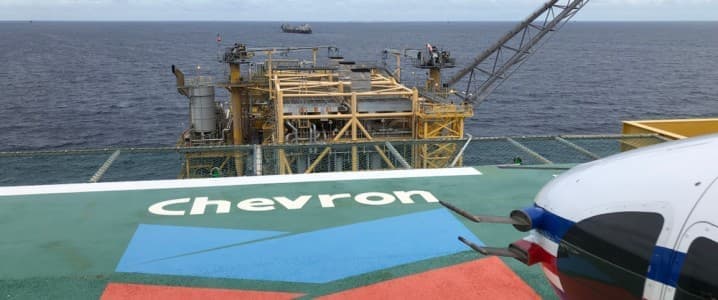
U.S. oil major Chevron Corp. (NYSE:CVX) has signed a memorandum of understanding with Qatari firm UCC Holding and Syria’s National Oil Company (NOC), the Syrian Petroleum Company, to explore for oil and gas in offshore Syria, a region lying between major gas discoveries in Israel and Egypt, Reuters has reported.
Currently, Syria gets the lion’s share of its oil production from onshore fields in the northeast, including the Al-Omar field. Syria is geographically close to the prolific Leviathan gas field, as both are located in the Eastern Mediterranean’s Levantine Basin. The Leviathan field is situated approximately 130 km (about 80 miles) off the coast of Haifa, Israel, placing it in the same geological region as the Lebanese and Syrian offshore waters.
The Syrian oil sector is undergoing significant changes following the collapse of the previous regime, with the government actively seeking to regain control and rehabilitate key oil and gas fields in the northeast. Previously, the oil sector was heavily fragmented, with major fields held by the Syrian Democratic Forces (SDF) and U.S. forces, while the Damascus government faced severe shortages.
The landscape is currently shifting towards state control over these resources, with key infrastructure, including the Baniyas refinery, being rehabilitated to process locally produced crude. Syria’s production has climbed from lows of 24,000-34,000 bpd during the conflict period from 2014 to 2019, approaching an estimated 100,000+ bpd in 2026, though output remains well below the pre-2011 output of nearly 386,000 bpd. Syria is home to ~2.5 billion barrels of proven oil reserves.
This is not Syria’s first foray to expand its fossil fuel production.
Back in December 2013, Soyuzneftegaz, a private Russian company led by former Energy Minister Yuri Shafranik, signed a 25-year, $90 million contract with the Syrian government to explore Block 2, a 2,190 square kilometer area in the Mediterranean Sea off the coast between Tartous and Banias. The agreement covered exploration, development, and production in offshore waters. While Soyuzneftegaz initially committed to funding surveys and drilling, the project was frozen and later abandoned in 2015, with the Russian company citing high risks from the ongoing civil war.
By Alex Kimani for Oilprice.com
More Top Reads From Oilprice.com



