
Real Estate
Quebec real estate posts one of its strongest years on record

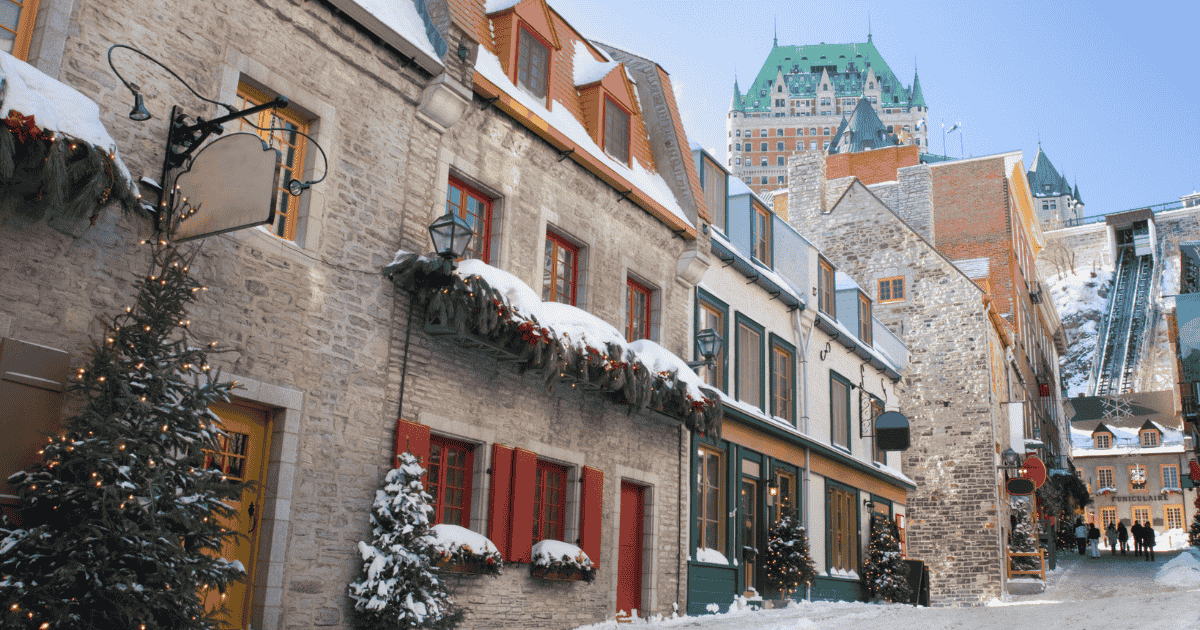
Quebec City in winter (Canva)
The Quebec real estate market continues to stand apart, bucking national trends.
Unlike much of Canada, Quebec’s residential market saw surprisingly strong activity in 2025 — a boom in many areas. Sales increased in all segments despite economic uncertainty and sharply lower supply.
Astonishingly, it was La Belle Province’s third-best year ever, with sales rising by an average of eight per cent over the previous year and prices climbing about nine per cent, according to a recent report from the Quebec Professional Association of Real Estate Brokers (QPAREB).
Favourable financing conditions helped fuel the surge, including declines in interest and mortgage rates and the extension of the maximum mortgage amortization period. Soaring rental costs have also pushed more Quebec renters to buy.
Homes in Quebec — now outperforming those in Ontario and British Columbia — remain significantly cheaper, making them attractive to buyers priced out of those softening markets (domestic buyers dominate the Quebec market due to the foreign buyer ban).
Beautiful, forested and heritage-rich Quebec — Canada’s largest province by area and the only one with a francophone majority — has once again proved to be a resilient nonconformist during a national slowdown.
Affordability pressures mount
The province’s momentum has come at a cost, putting pressure on prices and “exacerbating the issue of affordability,” says Charles Brant, QPAREB’s director of market analysis.
“A growing number of households reached the limits of their debt capacity, which slowed the pace of sales,” he said, referring to the final months of last year. The trend may signal a gradual deceleration in 2026.
The province’s listing-to-sales ratio is nearing historically low levels, underscoring a pronounced shortage of property listings and a market that heavily favours sellers.
Brant predicts that along with deteriorating affordability, particularly in the southern regions of the province, “The persistent low inventory of properties throughout Quebec will also contribute to a plateau in transaction activity in many Quebec markets. These market conditions — which remain very favourable for sellers — will continue to support prices.”
Like many experts, he expects price growth this year to be more moderate.
The Canadian Real Estate Association echoed that view in a recent forecast, predicting that home prices in Quebec will continue rising at a healthy pace this year, though “markedly lower than the gains recorded in 2025.”
Quebec City leads the surge
QPAREB’s data from the the past year and early 2026 shows that most metropolitan areas in the province have posted sustained growth in sales, often accompanied by a sharp decline in inventory.
The standout market is Quebec City, which experienced its strongest residential price growth on record. The median price of single-family homes there jumped an eye-popping 17 per cent to $450,000, making it one of Canada’s hottest housing markets.
“Exceptional scarcity translated into particularly sharp price increases,” said Camille Laberge, the association’s senior economist.
In Montreal, the median price has climbed to about $635,000 — not as dramatic an increase as in Quebec City or Saguenay, but still notable.
Resort regions such as Mont-Tremblant and the Eastern Townships are also experiencing intense activity, attracting affluent buyers seeking outdoor lifestyles and investment opportunities. A recent Engel & Völkers release also pointed to increased activity in Montreal’s luxury housing segment.
While the province’s slower-paced condo market has seen a slight improvement in supply, inventory pressure remains intense for single-family homes and “plex” properties. (The abundance of multi-unit dwellings such as duplexes and triplexes is an iconic feature of Quebec housing.)
The provincial real estate association continues to push for increased housing supply in hopes of easing the imbalance.
Agents adapt to a new reality
It wasn’t long ago that Quebec was regarded as a province without major housing market fluctuations. Local agents are now adjusting to a very different reality.
“There is still a real willingness to buy, especially for turnkey, well-located homes and solid income properties,” said Josiane Pepin, vice-president of operations at Remax Bardagi in Montreal.
“Quebec City is currently the most active, with a very tight balance between supply and demand. Greater Montreal is also strong because of its sheer volume and constant buyer pool, but it is more price-sensitive and the higher end takes more time. Gatineau remains robust.”
The provincial real estate association and regulator have also been busy.
“We are well regulated, but all the information is not known by the public,” said Remax broker Nicolas Geoffroy-Brûlé, who oversees offices in Quebec City and Trois-Rivieres. “It’s a local challenge to explain the rules to our clients.”
His — unlikely to be fulfilled — wish is for a period of stability for organized real estate.
“No changes for now, so all the agents have time to assimilate all the changes the government imposed in the past few years,” he said.
Those changes include improved transparency in transactions, stronger consumer protection, tighter rentals and condo reform. The provincial association also has its hands full dealing with concerns around the province’s upcoming new regulatory framework regarding updated flood zone maps, which has some homeowners worried their housing values could plunge.
Slowing population growth — particularly in Montreal — could dampen housing demand. On the other hand, major government-backed investment projects, including the proposed high-speed rail link between Toronto, Montreal and Quebec City, could rekindle interest.
Qui vivra verra.


Susan Doran is a Toronto-based freelance writer who has been contributing to REM since its very first issue.


Why is Team Italy rolling with Aaron Nola over Michael Lorenzen against Venezuela in World Baseball Classic SF? White Sox vet explores reasoning

Just 24 minutes of specially designed music could significantly reduce anxiety

JBL’s Best Wireless Headphones Are $170 Off at Walmart

Bob Vylan Banned From U.S. Over Glastonbury Controversy

For five older job seekers, finding new work took creativity, new skills and, in some cases, lowered expectations
