
Economy
Reducing energy risk in manufacturing: Low-energy strategies for critical minerals processing and industrial resilience

Battery recycling as a supply chain and energy storage enabler
The same logic applies to battery materials and recycling. Taylor notes that the company recently completed a year-long validation process to recycle lithium iron phosphate (LFP) batteries—the chemistry widely used in energy storage systems.
“If I can take your end-of-life energy storage units and recycle them back to battery-grade materials, it’s strengthening the supply chain and probably lowering the cost,” he says.
To install a microgrid or use any transmission of solar or wind power, the facility will likely need integrated energy storage for those variable power sources. For manufacturers deploying on-site energy storage, recycling closes the loop and improves the long-term economics of resilience strategies.
“I’m not only strengthening the supply chain for critical materials, but I’m also lowering the cost because it’s cheaper to recycle than to go mine it all again,” Taylor says. “Things really start to stack up, and you start to build a lower cost, more sustainable supply chain.”
Modular processing and smarter capacity planning makes strong supply chains
Energy efficiency is not only about how processes run, but how facilities scale, especially in burgeoning U.S. industries. “One of the challenges with large industrial processes is you normally have to build to nameplate capacity,” Taylor says. “So you’re incurring holding costs and energy costs for underutilized assets.”
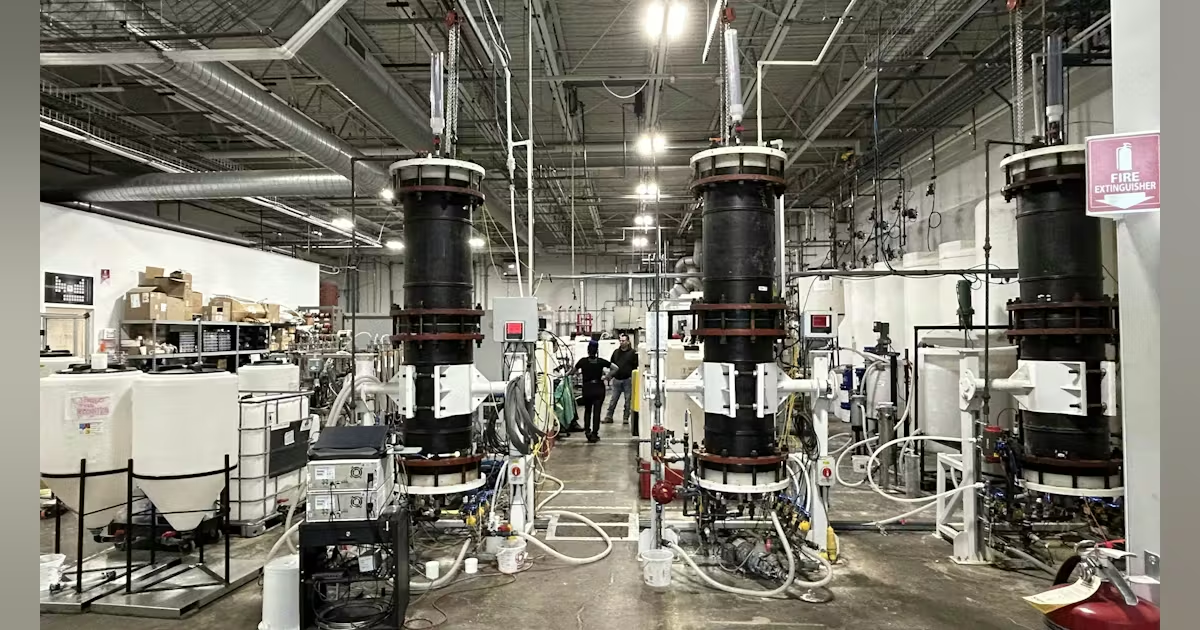
ReElement’s modular technology approach allows capacity to be added incrementally, aligning production with actual demand. “Our technology allows you to incrementally add production without overpaying for capacity when it’s not used,” Taylor explains. “That way we’re scaling smartly and not adding redundant cost.”
For plant leaders, modularity reduces both idle energy consumption and the reliability risks associated with oversized, underutilized systems. The modularity of the technology helps scale globally too, depending on where material is mined. For example, when working with a lithium miner in South Africa, does it make sense to ship mined rock across the Atlantic? Or does it make more sense to take the technology there? “Now, I’m only shipping pure lithium carbonate across to battery manufacturers,” Taylor adds. “Now I’m reducing the cost and energy usage of the transportation stage of the supply chain.”
ReElement Technologies interacts the same way with customers. Transportation and logistics represent a significant energy cost in global supply chains, particularly when raw materials are shipped long distances for processing. “If we can co-locate with a magnet producer or battery producer, there’s optionality to fully integrate into their production line, so I don’t have the energy cost and the labor costs of shipping material, packing material, unpacking material. I take out all those costs,” Taylor says. “Now I’ve started to build a more resilient, lower cost supply chain that can compete globally.”
Co-locating refining operations near mines, or near end users like battery and magnet manufacturers, can dramatically reduce transportation energy, handling costs, and supply chain risk.


China warns Trump's latest tariff moves could damage trade ties

Trump Declares Victory Over Iran Even as the Conflict Escalates

Trump warns NATO to help secure Strait of Hormuz or face ‘very bad future’ – National

Bob Vylan Banned From U.S. Over Glastonbury Controversy

For five older job seekers, finding new work took creativity, new skills and, in some cases, lowered expectations
